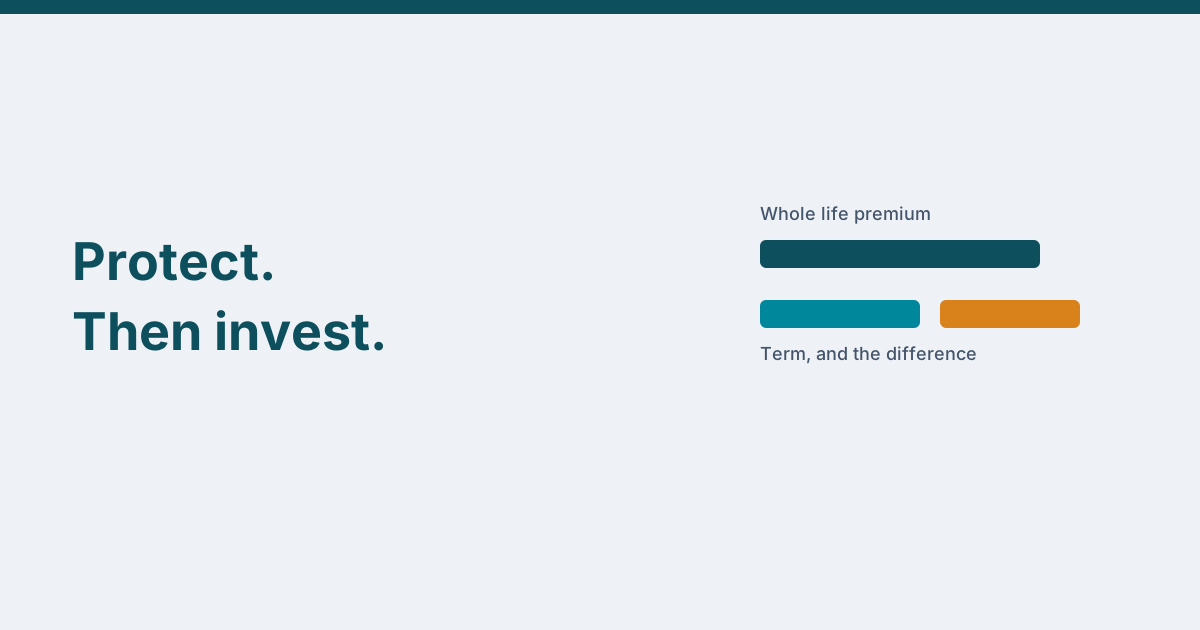
MoneySense: term cover is for a fixed period and usually costs less; whole life, endowment and ILP bundle protection with savings or investment, cost more, and the non-guaranteed part is investment risk you bear. This calculator compounds the premium gap once a year at the end of the year. It ignores taxes, fund fees beyond the premium you typed, and the chance you stop paying. A higher assumed return makes the invested pot larger. It does not make that return likely.
How we calculate
The gap is the bundled premium minus the term premium. It is saved at the end of each year. At 0% the pot is the gap times the years. Above 0% it is the ordinary future value of that annuity. The last tile subtracts a surrender value only if you typed one.
Inputs
- Annual term premium
- Annual bundled premium
- Years
- A return you choose
- Optional surrender value from an illustration
Assumptions
- 0% is the default and is not a forecast
- The return is yours, not an illustrated bonus
- Tax, lapses and charges outside the premium are ignored
Constants and where they come from
| Constant | Value used | Source |
|---|---|---|
| Why term is usually cheaper | MoneySense: term is unbundled and typically has no cash value | moneysense.gov.sg |
On this page
Key takeaways
- Term pays if you die or are totally and permanently disabled during the term. It does not build cash value.
- Participating whole life and endowment add non-guaranteed bonuses. You bear that investment risk.
- An ILP sells units to pay for cover and fees. The remaining units are the investment.
- Invest the premium gap only at a return you are willing to type. We do not supply an illustrated rate.
The numbers
- Term
- Fixed period, usually the lowest premium, no cash value
- Participating whole life
- Lifelong cover plus non-guaranteed bonuses
- Non-participating whole life or endowment
- Guaranteed cash value only, no bonuses
- ILP
- Units bought with the premium, then sold to pay for insurance and fees
- MAS sizing guide
- 9 times income for death and TPD, 4 times for critical illness
The short answer
Buy the insurance for the years someone depends on your income. That is what term is for. Buy a whole life, endowment or investment-linked policy when you want the savings or investment feature and you have read what is guaranteed. MoneySense puts term on one side of that line and the bundled products on the other.
| Term | Participating whole life | Non-participating endowment or whole life | ILP | |
|---|---|---|---|---|
| What it is | Cover for a fixed period | Lifelong cover plus bonuses | Cover plus a guaranteed cash value, no bonuses | Cover plus units in a fund |
| Premium | Usually the lowest | Higher | Higher | Higher, and charges continue |
| Cash value | Typically none | Guaranteed benefits plus non-guaranteed bonuses | Guaranteed benefits only | Whatever the units are worth |
| Investment risk | None | You bear the risk on the bonuses | None on the guaranteed value | You bear the fund risk |
| Premium pattern | Level for the term, then repriced if you renew | Usually level | Usually level | Premium can be level while units are sold to pay charges |
The surrender value of a bonus is not the same number as the cash value printed in a headline. On an ILP, some of the units you buy are sold to pay for the insurance and the fees. The rest stay invested. Neither fact is a reason to avoid the product. It is the reason the premium is a poor proxy for the cover.
Pages in this cluster
This guide is the hub. Each question below has its own page:
- whole life vs term
- buy term invest the rest
- buy term and invest the difference
- whole life insurance singapore
- investment linked policy singapore
- ilp vs term insurance
- endowment vs term
- participating whole life
- cash value life insurance
- term vs whole life singapore
The gap, without a made-up return
The calculator subtracts the annual term premium from the annual bundled premium and compounds that gap at the end of each year. At 0% it is just the premiums you did not spend. At a rate you type, it is that rate, labelled as your assumption. It is not the participating fund’s illustrated rate and not a historical return.
If you have a benefit illustration, type the surrender or cash value at the same year. The last tile is the invested pot minus that illustration. A positive number means the pot is larger at the return you assumed. It does not mean you will achieve the return, and it ignores the chance you stop the term plan, spend the gap, or still need cover on the day the term ends.
Size the term sum assured before you celebrate a cheap premium. The MAS Basic Financial Planning Guide uses 9 times annual income for death and total permanent disability, and 4 times for critical illness, with premiums inside 15% of take-home pay. Our gap calculator applies those multiples and then subtracts DPS and the cover you already hold. A whole life policy you already own counts in that cover. Cancelling it to “invest the difference” can create a new gap if the replacement term is smaller or excludes a condition the old policy covered.
What people mix up with this choice
CPF LIFE is the retirement income annuity. It is not a substitute for term insurance while you are working, and a whole life policy kept for its cash value is not a substitute for CPF LIFE. The CPF LIFE comparison uses the published 2026 payouts.
A child endowment does not insure the parent who pays for the household. If the parent dies, the endowment’s small sum assured is rarely the 9 times income the family needed. Term on the parent, kept to the year the children are independent, is the product that matches that sentence. The education plan page and the endowment guide are that split. Universal life and takaful ILPs are different contracts again. Dependants’ Protection Scheme is the CPF term base, not the whole sum.
Direct Purchase Insurance is the zero-commission shelf on compareFIRST, capped at S$400,000 of death cover per insurer. Use it as a slice, then price the rest. We do not publish a league table of whole life premiums, because the honest price is the illustration for your age and the sum assured, not a number copied from someone else’s quote.
What you need before a quote
- Annual income and take-home pay
- Cover you already hold, including DPS if you are in it
- The two annual premiums, if you are comparing term with a bundle
- A surrender value copied from an illustration, if you have one
Other ways to compare in Singapore
- compareFIRST, the life-insurance shelf MoneySense points to. Direct Purchase plans there are commission-free up to the published cap.
- The insurer's own site, if you already know the product and want its illustration.
- A licensed insurance broker you choose. We do not name one and we do not publish a phone number for one.
- A bank that distributes the policy, if that is where you bank. Ask them what they are paid. We do not list a rate.
- The calculators on this site, which show a result before you send a form.
Questions on this topic
Is buy-term-and-invest always better?
No. It is better when you will actually invest the gap, for the years the term lasts, in something you understand, and when the term sum assured matches the need. If the money stays in a current account, you have bought less insurance and saved nothing. If you still need cover after the term ends, the whole life policy was doing a job the term will not do.
Why not use the insurer's illustrated return?
The illustrated non-guaranteed bonus is the insurer's projection under a stated set of assumptions. It is not a promise, and it is not comparable with a deposit or a stock fund unless you read the charges. Paste the surrender value from the illustration into the calculator if you have it. Leave the return box as your own assumption, including zero.
Does whole life cost more because the cover is better?
The death benefit can last for life, which term does not. Part of the higher premium is also savings. MoneySense says bundled products generally cost more, and that you should buy the features you need rather than a package that happens to include them.
Where does Direct Purchase Insurance fit?
DPI term and whole life plans are sold with no commission, including on compareFIRST. The sum assured is capped at S$400,000 per insurer. On term that includes critical illness, that benefit is capped at S$200,000. Commission-free is not the same thing as the cheapest cover once you are above the cap.
What about an endowment for a child?
An endowment is a savings policy aimed at a date, with protection bolted on. It is not a cheap way to insure a parent. Insure the parent's income with term if that is the risk, and treat the child's endowment as a separate, often expensive, savings contract. Read the guaranteed cash value at the year you might have to stop paying.
Is it free?
Yes. The calculators and guides are free. A result appears in your browser before anyone asks for a phone number. Sending the form, if you want quotes for those figures, does not add a fee on this website.
Will you call me?
Not because you opened a page. We contact you only if you send the form or message us. You can read every result with the form left blank.
How does this site work?
The page does the arithmetic in your browser from the rules and the numbers you type. If you ask for quotes, we use your name, number and those figures only to reply about that enquiry. We do not sell the list. Personal data is handled under Singapore's Personal Data Protection Act. We are not an insurer and this is not financial advice.
Get a personalised breakdown
The calculator above runs in the browser with no phone number. Leave your details only if you want quotes or an audit for the same figures.
Sources
Facts on this page were checked against these sources on 30 October 2026.
- MoneySense: Life insurance, comparing term and bundled products moneysense.gov.sg, checked 30 October 2026
- MoneySense: Insurance basics and compareFIRST moneysense.gov.sg, checked 30 October 2026
- MAS: Basic Financial Planning Guide mas.gov.sg, checked 30 October 2026
- compareFIRST comparefirst.sg, checked 30 October 2026
Fact-checked against HDB, IRAS, CPF, MAS.