On this page
Key takeaways
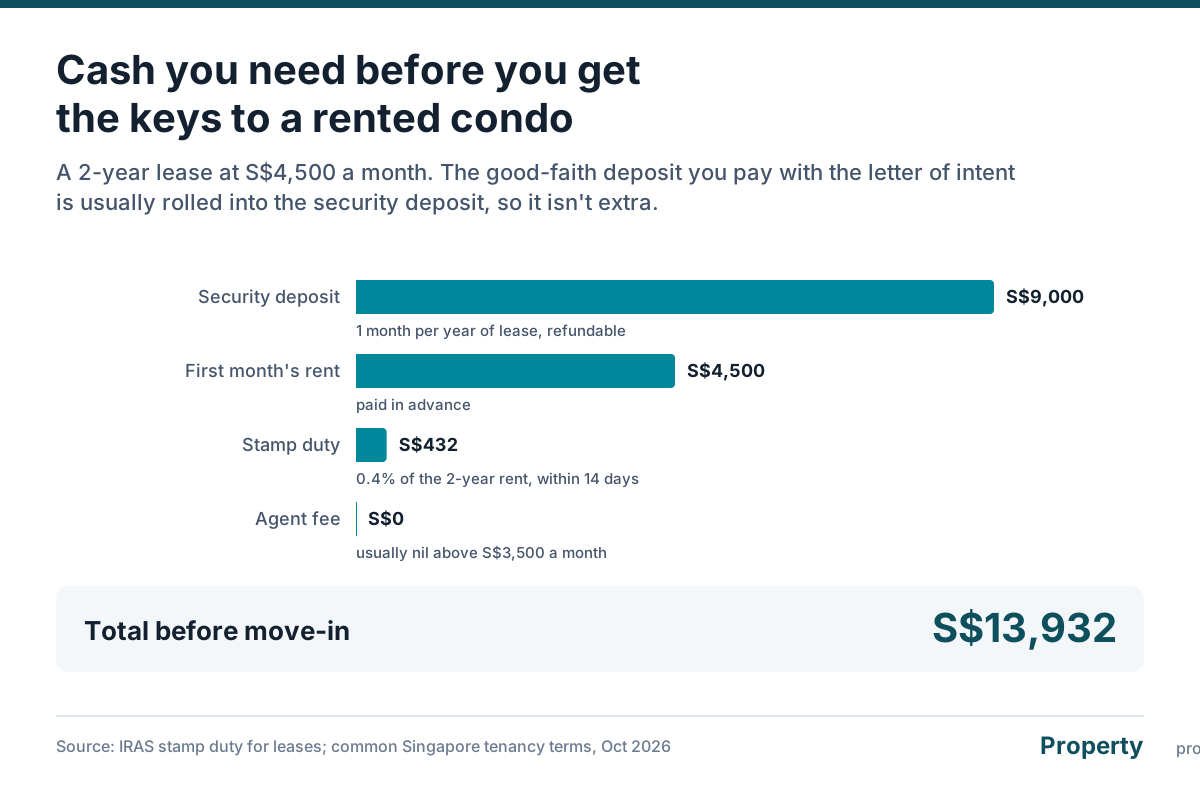
- 1 month's rent per year of lease is the usual security deposit, refunded at the end less damage.
- A diplomatic clause exists only if your agreement contains one. Lock-in, notice and resignation are whatever that clause says.
- A repair cap is negotiated. There is no statutory S$150 or S$200 limit.
- 0.4% of the total rent is the stamp duty, due within 14 days; leases with total rent of S$1,000 or less are exempt.
The numbers
- Good-faith deposit
- Usually 1 month, with the letter of intent
- Security deposit
- 1 month per year of lease
- Diplomatic clause
- Only the trigger, lock-in and notice in your draft
- Minor repairs
- A negotiated cap, not a statutory amount
- Stamp duty
- 0.4% of total rent, within 14 days
- Lease length
- 1 or 2 years; 3 months minimum for private homes
How a rental deal comes together
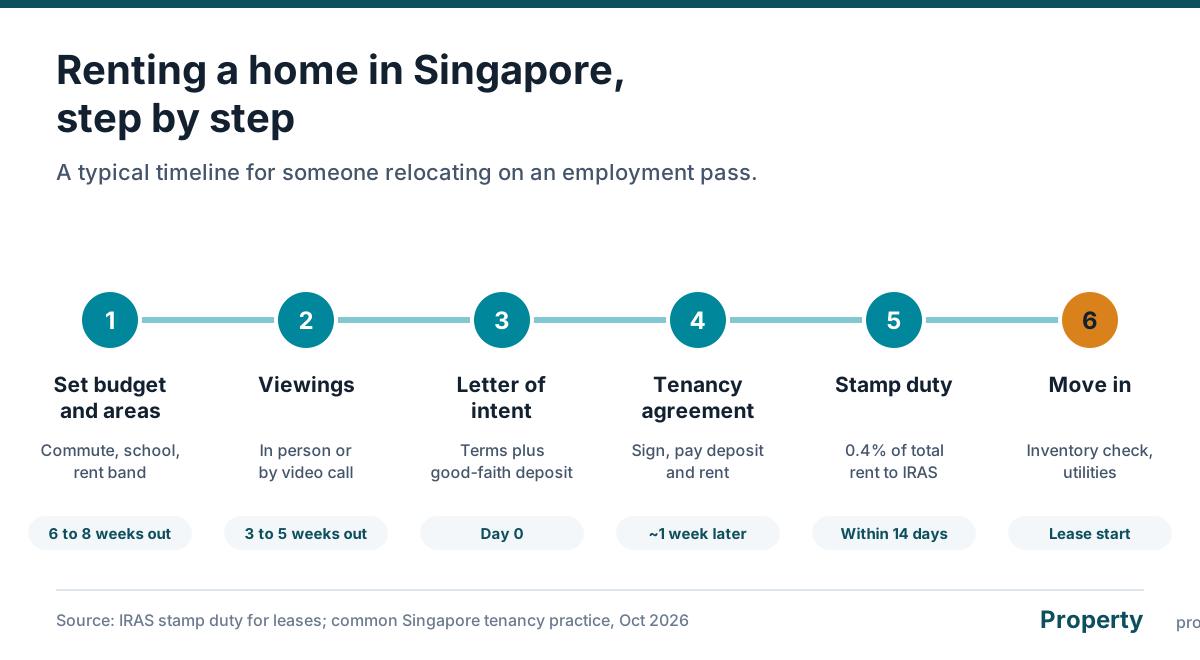
- Letter of intent (LOI). Once you’ve chosen a home, your agent sends the landlord an LOI with the rent, lease length, move-in date and any conditions, such as new curtains or removing a bed. You pay a good-faith deposit, usually one month’s rent. If the landlord accepts and then backs out, you get it back. If you back out, you usually lose it.
- Tenancy agreement (TA). The landlord’s agent drafts the TA, often within a week. The good-faith deposit is rolled into the security deposit.
- Signing and payments. You pay the rest of the security deposit and the first month’s rent, then stamp the TA with IRAS within 14 days.
The clauses to check
Rent, deposit and payment
- Security deposit: usually one month per year of the lease. Check when it’s returned, typically within 7 to 14 days after you hand back the keys.
- Payment date and how you pay. Late payment interest is common; make sure it’s reasonable.
Diplomatic clause
There is no statutory diplomatic clause. If your job can move, negotiate the trigger, the lock-in and the notice, and read diplomatic clauses before you treat “12 months and two months’ notice” as the law. A draft often looks like that. Yours may not. Resignation is a different event from a cancelled pass.
Minor repairs
Any cap is negotiated. Two different sentences produce two different bills, and neither is a statutory S$150 or S$200. The worked invoices are on deposits, repairs and handover. Check whether the tenant pays the first dollars and the landlord pays the excess, or the landlord pays the whole bill once it crosses the cap.
Aircon servicing
Tenants usually have to service the aircon every three months and keep the receipts. Chemical washes and gas top-ups are often the landlord’s. Ask for the units to be serviced before you move in.
Fair wear and tear
You don’t pay for normal ageing of paint, carpets or fittings. You do pay for damage. An inventory list with photos, signed by both sides at move-in, settles most arguments at the end.
Option to renew
An option to renew for another year, with the rent to be agreed or capped, saves you a move if you stay longer. Landlords don’t have to offer one; ask in the LOI.
Pets, guests and subletting
Most TAs ban subletting and Airbnb-style short stays, which are illegal for private homes anyway. If you have a pet, get written consent in the TA.
Stamp duty
You pay 0.4% of the total rent for leases of up to 4 years. A 2-year lease at S$4,500 a month means S$108,000 in rent and S$432 in duty. Pay it on IRAS’s e-stamping site within 14 days of signing, or 30 days if you signed outside Singapore. Leases with total rent of S$1,000 or less are exempt. Late payment carries a penalty. Work out your figure with the stamp duty calculator.
Agent fees
There is no rent level at which a tenant’s fee becomes compulsory or free. You pay a fee only if you appoint an agent and agree it first. The landlord’s agent cannot charge you as well. Search the advertised phone number, not just a card photo, on the CEA register. The checks are on rental agent fees. Sale commissions, which are a different market, stay on property agent commission.
When the lease ends
Give notice as the TA requires, usually 1 to 2 months before the end. Restore the home to its move-in condition, service the aircon a final time and clean it. Do the handover with the inventory list and photos. If the landlord deducts more than you think is fair, ask for receipts. Disputes up to S$20,000 can go to the Small Claims Tribunals.
For the bigger picture, read renting in Singapore as a foreigner.
Deposits, notice and stamp duty
Customs vary by landlord. These are the figures most Singapore tenancies actually use, and the two that IRAS sets.
| Item | Usual figure | Who sets it |
|---|---|---|
| Good-faith deposit with the letter of intent | 1 month’s rent | Market custom |
| Security deposit | 1 month’s rent for each year of the lease | Market custom |
| Diplomatic clause on a 2-year lease | Leave after 12 months, with 2 months’ written notice and proof of the posting | Negotiated clause |
| Minor repairs the tenant pays | The first S$150 to S$200 of each item | Negotiated clause |
| Stamp duty | 0.4% of the total rent for a lease of up to 4 years | IRAS |
| When stamp duty is due | 14 days after signing in Singapore, 30 days if signed overseas | IRAS |
| Leases exempt from stamp duty | Total rent of S$1,000 or less | IRAS |
| Private-home minimum stay some landlords write in | Often aligned with the 3-month minimum tenants expect to see | Negotiated |
Stamp duty is the tenant’s bill by custom, unless the agreement says otherwise. Pay it on IRAS’s website and keep the certificate with the lease. The guide for foreigners renting covers the steps before you reach this document, including the HDB quota if the home is a flat rather than a condo.
Questions on this topic
What is a diplomatic clause in Singapore?
A contract term, not an automatic right. It works only for the events, lock-in and notice written in your agreement. Resignation is included only if the clause says so. Losing a pass does not end a lease that has no such term. The detail is on the diplomatic clause page.
Who pays stamp duty on a tenancy agreement in Singapore?
By custom the tenant, though the agreement can say otherwise. It is 0.4% of the total rent for leases of up to 4 years, paid on IRAS's website within 14 days of signing, or 30 days if signed outside Singapore. Leases where the total rent is S$1,000 or less are exempt.
How much is the security deposit for renting in Singapore?
Usually one month's rent for each year of the lease: one month on a 1-year lease, two on a 2-year lease. The landlord returns it at the end, usually within 7 to 14 days, less the cost of damage beyond fair wear and tear and any unpaid bills.
Can a landlord keep the deposit in Singapore?
Only for damage beyond fair wear and tear, unpaid rent or bills, or a breach of the agreement. Disputes up to S$20,000 can go to the Small Claims Tribunals. Photos and an inventory list signed at move-in are the best protection.
Can I break my lease in Singapore?
Without a diplomatic clause, breaking a lease usually means losing the security deposit and possibly paying rent until the landlord finds a new tenant, plus part of the agent commission. Read the early termination clause before signing.
Get a rental shortlist
Tell us your budget, bedrooms and where you'll work. We'll send available homes that fit, with the rent, the commute and the upfront costs.
Sources
Facts on this page were checked against these sources on 8 November 2026.
- IRAS: Stamp duty for renting a property iras.gov.sg, checked 8 November 2026
- Small Claims Tribunals: Tenancy disputes judiciary.gov.sg, checked 8 November 2026
- URA: Minimum rental period for private homes ura.gov.sg, checked 8 November 2026
Fact-checked against HDB, IRAS, CPF, MAS.