
On this page
Key takeaways
- Term is cover for a stated number of years.
- Whole life is cover that can last for life, plus cash value.
- Bundled premiums are generally higher.
- Match the product to the years someone depends on your income.
The numbers
- Term
- Fixed period, usually cheapest, typically no cash value
- Whole life
- Can last for life, has cash value
- Who bears bonus risk
- You, on a participating policy
- MAS death guide
- 9 times annual income
- Premium guide
- Within 15% of take-home pay
The short answer
Whole life versus term is a question about the job. Term insurance covers death, and often total and permanent disability, for a fixed period. It is usually the cheapest way to buy a large sum. If you are alive at the end, the cover stops and there is typically no cash value. Whole life is built to stay in force for life, as long as you pay, and part of the premium builds a cash value.
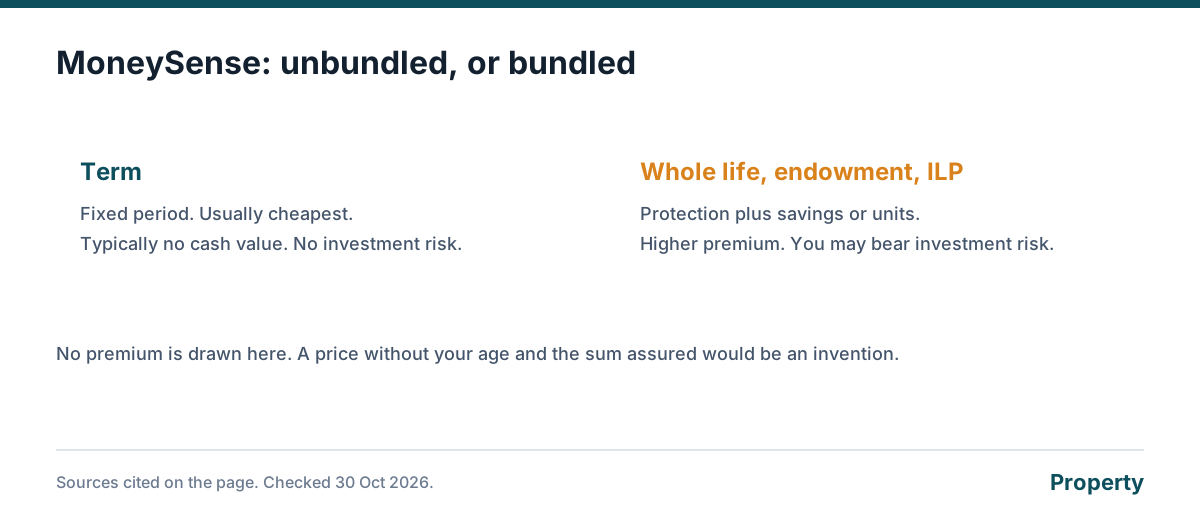
MoneySense puts term on one side and whole life, endowment and investment-linked policies on the other. The bundled side costs more. The non-guaranteed part is investment risk you bear.
Match the years to the people
The years that need a large payout are usually specific. A partner who could not pay the mortgage. Children who are not yet working. A loan that ends on a date. Term can be aimed at that date. Whole life is what you buy if you want some cover on the day you die at 85, or if you want the savings feature and you have read what is guaranteed.
The MAS Basic Financial Planning Guide uses 9 times annual income for death and total permanent disability, and 4 times for critical illness, with all premiums inside 15% of take-home pay. Those multiples do not say “buy whole life”. They size the sum. A cheap term plan that hits 9 times is doing the guide’s job. A whole life plan that stops at a small sum because the premium was heavy is not.
| You need | The closer product |
|---|---|
| A large sum until the youngest child is independent | Term |
| The mortgage paid off if you die during the loan | Term, or a mortgage policy. HPS if CPF pays an HDB loan |
| Some cover whenever you die, plus a savings pot | Whole life, after you read the guaranteed column |
| A sum on a date, like a university year | An endowment, which is savings first. Not a cheap substitute for term on a parent |
| Investments you choose, with cover bolted on | An ILP, and watch the units sold to pay charges |
Do not let the bundle answer a different question
CPF LIFE is retirement income. It is not term insurance for a 40-year-old with dependants. A child’s whole life policy does not replace cover on the parent who earns the salary. The invest-the-rest page is whether you will really invest the gap. The feature table is MoneySense’s side-by-side. The hub holds the calculator, which only compounds a gap you type. We are not an adviser, and we will not invent a premium for a 35-year-old.
Send me quotes for these figures
What you need before a quote
- Flat type, or condo and floor area
- What the contents would cost to replace
- What the renovation cost
- Age of the building, if you care about seepage tracing
- Whether you live there or rent it out
Other ways to compare in Singapore
- compareFIRST, the life-insurance shelf MoneySense points to. Direct Purchase plans there are commission-free up to the published cap.
- The insurer's own site, if you already know the product and want its illustration.
- A licensed insurance broker you choose. We do not name one and we do not publish a phone number for one.
- A bank that distributes the policy, if that is where you bank. Ask them what they are paid. We do not list a rate.
- The calculators on this site, which show a result before you send a form.
Questions on this topic
Is whole life always better because it never expires?
Only if you still want cover after the children are grown and the loan is gone. Many households need a large sum for 20 years, not a smaller sum forever.
Does term leave nothing behind if I survive?
Correct. That is why it is cheaper. The premium you did not spend is yours only if you actually keep it.
Can I have both?
Yes. A term plan can fill the gap to the MAS 9 times income while a small whole life policy stays for life. Do not pay whole-life rates on the entire gap.
Where is the Singapore price?
On compareFIRST and on the illustration for your age. We do not publish a sample premium.
Is it free?
Yes. The calculators and guides are free. A result appears in your browser before anyone asks for a phone number. Sending the form, if you want quotes for those figures, does not add a fee on this website.
Will you call me?
Not because you opened a page. We contact you only if you send the form or message us. You can read every result with the form left blank.
How does this site work?
The page does the arithmetic in your browser from the rules and the numbers you type. If you ask for quotes, we use your name, number and those figures only to reply about that enquiry. We do not sell the list. Personal data is handled under Singapore's Personal Data Protection Act. We are not an insurer and this is not financial advice.
Get a personalised breakdown
The calculator above runs in the browser with no phone number. Leave your details only if you want quotes or an audit for the same figures.
Sources
Facts on this page were checked against these sources on 30 October 2026.
- MoneySense: Comparing term and bundled life insurance moneysense.gov.sg, checked 30 October 2026
- MAS: Basic Financial Planning Guide mas.gov.sg, checked 30 October 2026
- compareFIRST comparefirst.sg, checked 30 October 2026
Fact-checked against HDB, IRAS, CPF, MAS.
