
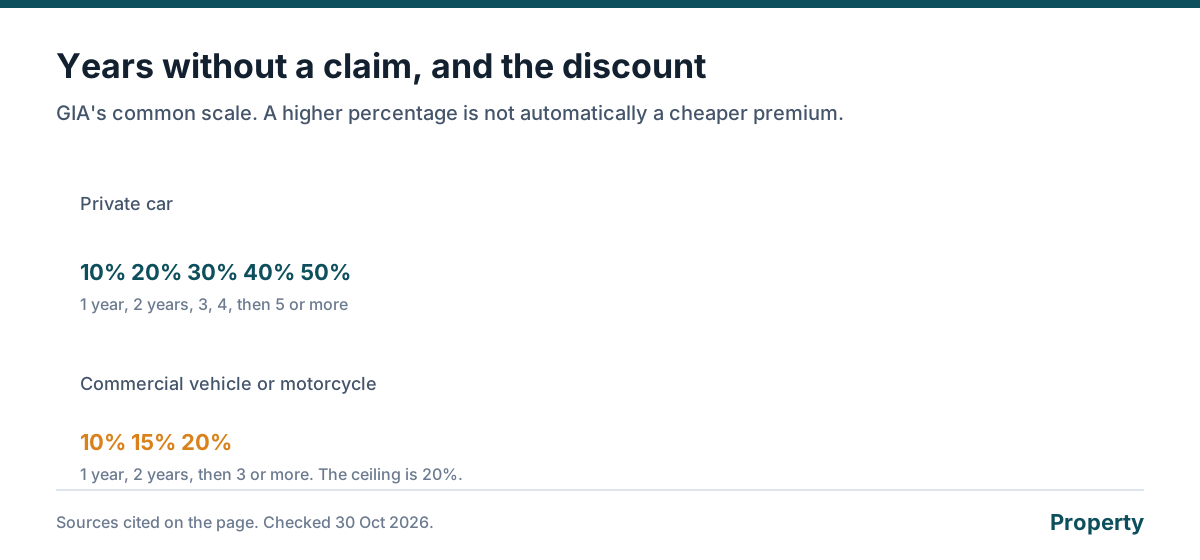
Private-car discounts step 10, 20, 30, 40, 50 percent. One claim takes 50 to 20, 40 to 10, and 30 or less to 0. Two claims go to 0. Commercial vehicles and motorcycles top out at 20 percent and drop to 0 on one claim. GIA's protector example is a private car already at 50 percent: one claim stays at 50 percent with the same insurer, and is 20 percent with a new insurer. A wholly not-at-fault claim may not move the discount. The protector does not stop an insurer refusing renewal.
How we calculate
The pre-discount premium is your current premium divided by one minus the current NCD, unless you typed the 0% premium. One private-car claim maps 50% to 20%, 40% to 10%, and 30% or less to 0%. The headline is the extra premium while that discount climbs back, holding the base flat. A protector at 50% keeps 50% only on a same-insurer renewal.
Inputs
- Vehicle type
- Current NCD
- Premium you pay now or the premium at 0%
- Claims this year
- Protector add-on you type
Assumptions
- The base premium does not get loaded after a claim
- A wholly not-at-fault claim may not move the discount. The tool does not decide fault
- GIA's protector table is applied only to a private car at 50%
Constants and where they come from
| Constant | Value used | Source |
|---|---|---|
| Private-car scale and one-claim cut | 10/20/30/40/50. One claim: 50 to 20, 40 to 10, 30 or under to 0 | gia.org.sg |
Key takeaways
- 50% is five or more claim-free years on a private car.
- Motorcycles and commercial vehicles never reach 50% on the common scale.
- One claim without protection: 50% becomes 20%.
- A higher percentage is not automatically a cheaper quote.
The numbers
- How you get there
- 5 claim-free years, private car
- One claim, no protector
- Renews at 20%
- Protector, same insurer, one claim
- Stays at 50%, on GIA's example
- Protector, new insurer, one claim
- 20%
- Motorcycle ceiling
- 20%, not 50%
The short answer
A 50% NCD is the private-car ceiling on GIA’s common scale. It means five consecutive years, or longer, without a claim that counted. It is not a rank you can buy, and motorcycles and commercial vehicles do not get there on that scale. Their ceiling is 20%.
At 50%, the renewal premium is half the insurer’s pre-discount premium, before any other loading. It is not half the price of a different insurer’s policy. GIA says so directly: shop the premium, not the percentage.
The calculator uses a premium you type. Put in what you pay now at 50%, or the premium at 0%, and it holds that base flat so you can see the discount rather than a guessed rate card.
What one claim does to the ceiling
Without a protector, one claim takes 50% to 20%. You do not fall to zero unless there is a second claim in the year, or you are on the commercial scale. The way back, if the next years are clean, is 30%, then 40%, then 50% again.
If the pre-discount premium stays flat, the points you give up are 30, then 20, then 10. That is 60% of one year’s undiscounted premium, paid as extra across three renewals. A protector, on GIA’s example, keeps the 50% if you renew where you are. Take the claim to a new insurer and the published figure is 20%, protector or not. The worth-it page compares the add-on with that hole. The switch page is only the new-insurer column.
| Starting at 50% | Next renewal |
|---|---|
| No claim | 50%. The scale does not go higher |
| One claim, no protector | 20% |
| One claim, protector, same insurer | 50% |
| One claim, protector, new insurer | 20% |
| Two claims, protector, same insurer | 20% |
| Two claims, new insurer | 0% |
Keeping the ceiling
The record can move to the next car you buy. It cannot be pasted onto a second car as well. A spouse gets it only if the insurer stays the same. A year or two without a car is usually survivable, often up to 24 months, sometimes 12. None of those moves increase 50% to something larger.
A not-at-fault accident with another vehicle may leave the 50% where it is. You still report it. The accident page is that sequence. This page is only the ceiling: how it is earned, why it is not a market-wide half price, and how fast one claim spends it. The hub is the index. We are not an insurer.
What you need before a quote
- Your no-claim discount and the renewal premium
- The protector add-on from the invite, if you are pricing one
- COE date and outstanding loan, if you are testing a total loss
Other ways to compare in Singapore
- compareFIRST, the life-insurance shelf MoneySense points to. Direct Purchase plans there are commission-free up to the published cap.
- The insurer's own site, if you already know the product and want its illustration.
- A licensed insurance broker you choose. We do not name one and we do not publish a phone number for one.
- A bank that distributes the policy, if that is where you bank. Ask them what they are paid. We do not list a rate.
- The calculators on this site, which show a result before you send a form.
Questions on this topic
Is 50% the legal maximum?
It is the top of the common scale GIA prints for private cars. An insurer can structure a product differently. Treat 50% as the usual ceiling, and read your schedule.
Does 50% mean I pay half?
You pay half of that insurer's pre-discount premium, not half of every other insurer's price. GIA says a higher discount can still produce a dearer quote.
If I am at 50% and I do not claim, do I go to 60%?
No. The scale stops at 50%. Another clean year keeps you at the cap.
How much is 50% worth in dollars?
Only against your pre-discount premium. The calculator turns the percentage into dollars from the premium you type. We will not invent one.
Is it free?
Yes. The calculators and guides are free. A result appears in your browser before anyone asks for a phone number. Sending the form, if you want quotes for those figures, does not add a fee on this website.
Will you call me?
Not because you opened a page. We contact you only if you send the form or message us. You can read every result with the form left blank.
How does this site work?
The page does the arithmetic in your browser from the rules and the numbers you type. If you ask for quotes, we use your name, number and those figures only to reply about that enquiry. We do not sell the list. Personal data is handled under Singapore's Personal Data Protection Act. We are not an insurer and this is not financial advice.
Get a personalised breakdown
The calculator above runs in the browser with no phone number. Leave your details only if you want quotes or an audit for the same figures.
Sources
Facts on this page were checked against these sources on 30 October 2026.
- GIA: No Claims Discount gia.org.sg, checked 30 October 2026
Fact-checked against HDB, IRAS, CPF, MAS.
