On this page
Key takeaways
- Cash value is the savings inside a bundled policy.
- The death benefit is a different number.
- Premiums paid are a third number.
- Surrender can pay less than the headline, especially on bonuses.
The numbers
- Cash value
- Savings inside the policy
- Death benefit
- What is paid if you die, under the contract
- Premiums paid
- What you put in. Often more than early surrender value
- Participating surrender
- Bonuses may be worth less than the headline
- Term insurance
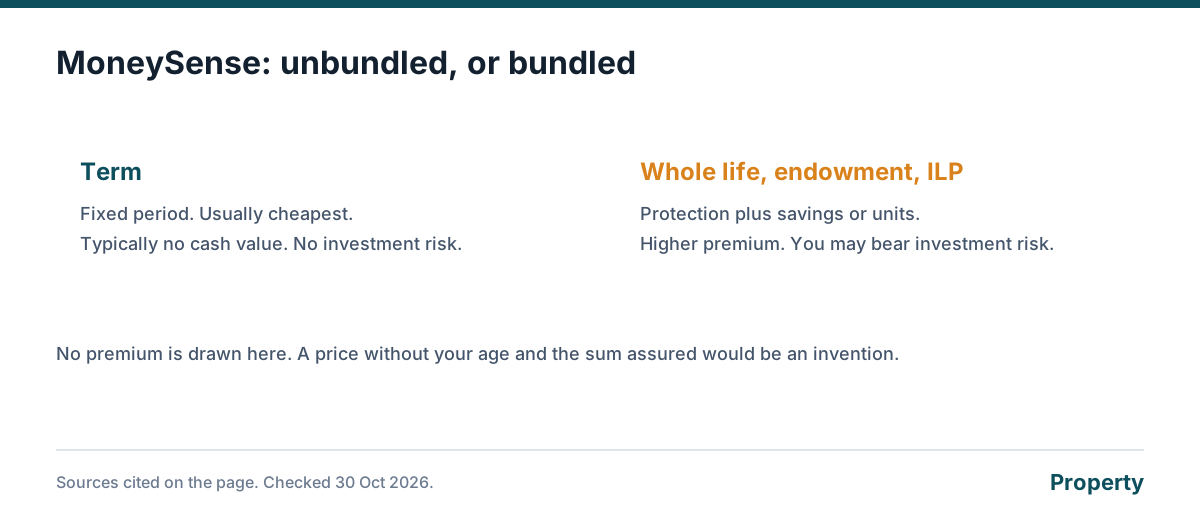
- Typically no cash value at all
The short answer
Cash value life insurance means a policy that stores a savings balance while it covers you. Whole life and endowment policies do this. Term insurance, on MoneySense’s description, typically does not. The cash value is not the amount your family receives if you die, and it is not a receipt for the premiums you have paid.
On a participating policy there is a further cut. The cash value you see can include bonuses. The amount you are paid if you surrender those bonuses may be less than that total. MoneySense states that directly.
Three numbers that get collapsed into one
Keep them apart when you read an illustration.
The death benefit is what the contract pays if you die. The cash value is the savings element if you give the policy up or, where it is allowed, borrow against it. The premiums paid are your cost. In the early years the third number is often larger than the second. That gap is why cancelling a policy in year three to “get my money back” is a frequent disappointment. We will not print a universal percentage for that gap. Your surrender column has the percentage that applies to you.
| Number | What it answers |
|---|---|
| Sum assured or death benefit | What is paid on death, on the contract’s terms |
| Cash value | What the savings element is said to be |
| Surrender value | What you actually receive if you quit, which can be lower |
| Premiums paid | Your cost. Not a floor under the surrender value |
| Illustrated non-guaranteed value | A scenario, not the cheque |
Using cash value in the term comparison
The invest-the-difference calculator on the hub has a box for this number. Paste the surrender value at the year you are comparing, not the maturity dream. The pot of invested term-premium differences is then set beside that pasted figure, at a return you chose. Leave the box blank if you do not have the illustration. An empty box is more honest than a cash value we made up.
The participating page explains why a bonus can shrink on the way out. The difference page is the formula. A policy with no cash value can still be the right purchase when the job is a large sum for 20 years. That is term. We are not an adviser.
Send me quotes for these figures
What you need before a quote
- Flat type, or condo and floor area
- What the contents would cost to replace
- What the renovation cost
- Age of the building, if you care about seepage tracing
- Whether you live there or rent it out
Other ways to compare in Singapore
- compareFIRST, the life-insurance shelf MoneySense points to. Direct Purchase plans there are commission-free up to the published cap.
- The insurer's own site, if you already know the product and want its illustration.
- A licensed insurance broker you choose. We do not name one and we do not publish a phone number for one.
- A bank that distributes the policy, if that is where you bank. Ask them what they are paid. We do not list a rate.
- The calculators on this site, which show a result before you send a form.
Questions on this topic
If I have paid S$20,000, is the cash value S$20,000?
Not as a rule. Early years often show a surrender value below premiums paid. That is a common reason not to treat the policy as a short-term savings account. Your illustration is the evidence, not a ratio we invent.
Is cash value paid on top of the death benefit?
Do not assume that. Many policies pay the death benefit, and the cash value is what you can access if you surrender while alive. Read which figure the contract adds.
Can I withdraw cash value and keep the full cover?
Some policies allow a loan or a partial withdrawal, and either can reduce the death benefit. Ask for the after-withdrawal sum assured.
Does term have a hidden cash value?
MoneySense says term typically has none. If a product has a cash value, it is in the bundled column.
Is it free?
Yes. The calculators and guides are free. A result appears in your browser before anyone asks for a phone number. Sending the form, if you want quotes for those figures, does not add a fee on this website.
Will you call me?
Not because you opened a page. We contact you only if you send the form or message us. You can read every result with the form left blank.
How does this site work?
The page does the arithmetic in your browser from the rules and the numbers you type. If you ask for quotes, we use your name, number and those figures only to reply about that enquiry. We do not sell the list. Personal data is handled under Singapore's Personal Data Protection Act. We are not an insurer and this is not financial advice.
Get a personalised breakdown
The calculator above runs in the browser with no phone number. Leave your details only if you want quotes or an audit for the same figures.
Sources
Facts on this page were checked against these sources on 30 October 2026.
- MoneySense: Comparing term and bundled life insurance moneysense.gov.sg, checked 30 October 2026
Fact-checked against HDB, IRAS, CPF, MAS.
