On this page
- The short answer
- What each contract is promising
- Who is doing the investing
- How the cash value is built
- How you pay, and what rises
- Premium holidays, withdrawals, and loans
- Death benefit, and the sum you think you bought
- The Seedly question: surrender the ILP and buy whole life
- When term is the actual answer
- Checklist before you pick
- What a free review needs from you
Key takeaways
- You choose the ILP sub-funds. The insurer invests a whole life fund.
- ILP cash value is the units, and it can fall to nothing.
- Participating whole life cash value mixes guarantees and bonuses.
- Term is the third option when the job is cover for a fixed period.
The numbers
- Who invests an ILP
- You, by picking sub-funds
- Who invests whole life
- The insurer
- ILP cash value
- Usually none guaranteed
- Participating cash value
- Guaranteed benefits plus non-guaranteed bonuses
- Versus term
- Both bundled products cost more for pure cover
The short answer
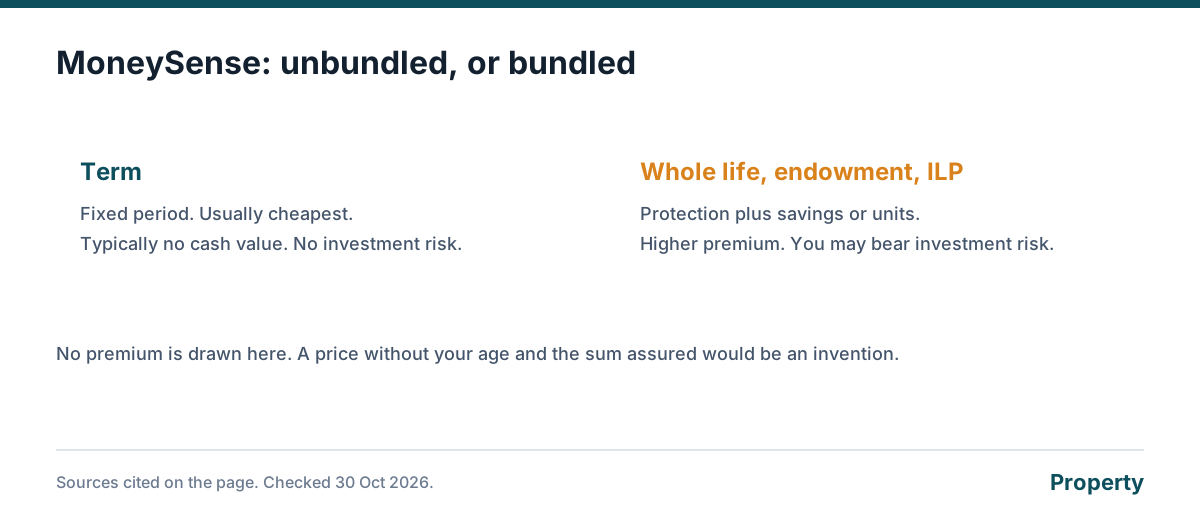
ILP versus whole life is a comparison of two bundles, not a comparison of an investment with insurance. MoneySense puts both on the protection-and-investment side of the line, and term on the protection-only side. Both bundles generally cost more than term. They create value in different ways, and the person who invests is different.
On an ILP, your premium buys units in sub-funds you select. Some units are sold to pay for insurance and other charges. What remains is invested, and you bear the risk. On a whole life policy, the insurer runs the investments. A participating policy’s cash value is guaranteed benefits plus future non-guaranteed bonuses, and you bear the investment risk of those bonuses. A non-participating whole life or endowment policy’s cash value is guaranteed benefits only, with no bonuses, and MoneySense lists investment risk as none.
Searchers type “ILP vs whole life” and “whole life insurance vs investment linked policy” because an adviser has put both quotations on the table, or because someone on Seedly asked whether to surrender an ILP and buy a limited-pay whole life plan. The ILP hub explains units. The whole life guide explains cash value and the direct purchase cap. This page is only the difference.
What each contract is promising
| Question | Investment-linked policy | Participating whole life | Non-participating whole life |
|---|---|---|---|
| Type, in MoneySense’s table | Bundled | Bundled | Bundled |
| Premium versus term | More, as a bundle | More than term | More than term |
| Cash value | Usually none guaranteed. Value is the units | Guaranteed benefits plus non-guaranteed bonuses | Guaranteed benefits only |
| Who chooses the assets | You, by selecting sub-funds | The insurer, inside the participating fund | The insurer |
| Investment risk | Yours, on the units | Yours, on the non-guaranteed bonuses | None, on MoneySense’s table |
| Premium | The regular premium can stay level while the insurance charge inside it rises | Typically constant, paid regularly | Typically constant, paid regularly |
| What you can change later | Often the funds, the premium, the sum assured, top-ups and withdrawals | Limited. Read the contract | Limited. Read the contract |
The death benefit is not a reason to skip this table. An ILP’s death or total and permanent disability benefit may be the higher of the sum assured or the unit value, or some combination of the two. A whole life sum assured is the amount in that contract, plus bonuses if it is participating and the bonuses have been declared. Do not put the two headline sums in one cell of a spreadsheet until you know which one moves with a market and which one moves with a bonus declaration.
Who is doing the investing
MoneySense draws this line in a single sentence. The investment strategy of an ILP is determined by your selection of the sub-funds. This is unlike whole life or endowment policies, where the insurer determines the investment strategy.
That sentence changes the homework. An ILP buyer has to be able to say what the chosen sub-fund invests in, and whether that risk matches a horizon. A whole life buyer has to be able to say that the insurer’s participating fund, or the guaranteed benefits of a non-participating policy, is the strategy they are accepting. One is a menu. The other is a kitchen you do not enter.
If you will not look at a fund factsheet, the ILP menu is a poor fit even when the whole life quotation looks old-fashioned. If you want to move between equity and bonds yourself, whole life will not give you that switch. Fund switching is an ILP feature, described on the switching page. It is not a whole life feature.
How the cash value is built
An ILP usually has no guaranteed cash value. MoneySense says you can potentially lose the entire value of the investment. Surrender value is the value of the units after charges, and a surrender charge can apply if you sell before a stated time. There is no bonus declaration that turns a non-guaranteed illustration into a vested guarantee. The unit price tomorrow is the value tomorrow.
A participating whole life policy does declare bonuses. MoneySense says the cash value comprises guaranteed benefits and future non-guaranteed bonuses, and that the surrender value of guaranteed bonuses may be less than the total cash value of the policy. You bear the investment risk of the non-guaranteed bonuses. A bonus that has not been declared is not yours. A bonus that has been declared and vested is treated differently again if an insurer fails. That second point is on the PPF page, because SDIC’s definition of guaranteed benefits for a participating policy includes bonuses that have been declared and vested.
A non-participating whole life policy is the plainer machine. Cash value is guaranteed benefits only. There are no bonuses. MoneySense lists investment risk as none. The premium is the price of those guarantees and of the lifelong cover. It can still be a poor price relative to term if you only needed twenty years of cover. “No investment risk” is not the same sentence as “this is cheap” or “you will be glad you bought it”.
How you pay, and what rises
ILP regular premiums are often quoted as a level amount. Inside that amount, the cost of insurance typically increases year on year as you age, even if the sum assured stays the same. More units are sold for insurance, and fewer units remain. MoneySense also says that for regular premium ILPs, insurers may increase the cost of insurance if there has been a sustained rise in claims, applied to a class of policies rather than to one person. The level debit is not a level cost of cover.
Whole life premiums on MoneySense’s table are typically constant and can be paid regularly. A limited-pay whole life policy concentrates those premiums into fewer years. The product summary says whether the premium is guaranteed for the payment term. Do not assume it is. If the quotation you were shown is a limited-pay participating plan, the endowment and whole life pages on this site separate the guaranteed column from the bonus column. Bring both columns to the comparison. An ILP illustration’s 0% column is the parallel document: it shows charges with no fund growth.
The Life Insurance Association template of 28 July 2026 says the ILP rates used in an illustration are before fund management charges, purely illustrative, and not upper or lower limits. A whole life illustration’s non-guaranteed column is also not a limit on what the participating fund will do. Comparing the highest illustrated ILP rate with the highest illustrated bonus scale is a comparison of two stories. Compare the guaranteed whole life surrender value with the ILP’s guaranteed column, which is often zero, and then decide whether you are paying for a guarantee or for a fund menu.
Premium holidays, withdrawals, and loans
ILPs are built to be altered. MoneySense says you may top up and make partial withdrawals, and most regular premium ILPs let you reduce or increase cover. The illustration template names premium holiday and partial withdrawal as events that can change when a policy value hits zero. Those moves are real, and they are also how a policy gets into trouble. The holiday, withdrawal and top-up pages are the procedures. Whole life contracts are generally not operated that way. Some allow a policy loan against cash value, or a partial surrender of bonuses. Whether yours does, and the interest on a loan, is in the contract. Check with your insurer. We did not find a single industry rule that every whole life policy can be borrowed against, so this page will not say you can.
If the feature you want is “I might need cash out in year seven without ending the cover”, ask both insurers in writing. An ILP partial withdrawal sells units and can trigger a surrender charge. A whole life withdrawal or loan reduces benefits in the way that contract states. They are not the same cheque.
Death benefit, and the sum you think you bought
Put the two death benefits in words, not in one number.
An ILP might pay a chosen sum assured, or the unit value if that is higher, or a percentage of premiums, or a percentage of the account value. The 101 page is the market nickname for the thin-cover end, where the death benefit is close to the premiums or the account. A protection ILP can have a sum assured far above the account, which is why the insurance charge matters more. MoneySense’s phrase is “the higher of the sum assured or the value of the units, or some combination of the two”. Your summary picks one of those shapes.
A whole life death benefit is the sum assured in the schedule, plus vested bonuses on a participating plan. It is not a unit price. It does not rise tomorrow because a market rose, and it does not fall tomorrow because a market fell, except to the extent a non-guaranteed terminal bonus would have been paid and is not guaranteed. Read the claim page of the contract for what is paid on death in the first years, because some policies have a different amount before a stated anniversary. Check with your insurer rather than assuming the brochure’s largest number is paid from day one.
Riders for critical illness can be attached to either contract. MoneySense says riders need additional premiums, and those premiums could increase with age. A rider that accelerates the sum assured reduces what is left as a death benefit. List riders separately. Do not let a critical illness feature on one quote decide a thirty-year investment comparison.
The Seedly question: surrender the ILP and buy whole life
A public Seedly question asks whether a person three years into an ILP should surrender and buy a limited-pay whole life plan to pay less premium for similar death, TPD and critical illness cover. The honest sequence is mechanical.
First, the ILP surrender value this week is the units after the surrender charge, and it moves until the insurer prices the sale. Copy it from the insurer, or from the latest statement plus the charge in the contract. The surrender guide is the form, by insurer. The calculator only repeats arithmetic you type.
Second, the whole life premium on a new application is a new underwriting decision. Age is higher than it was three years ago. Health may have changed. A lower illustrated premium on a healthy-life quotation is not an offer. Check with the insurer.
Third, “similar coverage” has to be the same sum, the same illnesses, and the same period. A whole life sum assured that is level for life is not the same shape as an ILP sum assured that depends on units staying above zero. A critical illness rider that accelerates is not a standalone critical illness plan. Write the three differences down before you call the premium smaller.
Fourth, early ILP years are often where allocation is lowest or the surrender charge is highest. Leaving in that window can turn most of the premiums into a charge. That is not a reason to keep a contract you do not want. It is a reason to see the number before you instruct the surrender. MoneySense’s point that front-end and back-end loading have a similar overall effect means you do not escape the bill by hoping the structure was the other kind.
When term is the actual answer
Both products fail the same test. If the job is a sum of money if you die during the years someone depends on your income, term is the product MoneySense calls the simplest and usually the most affordable, with typically no cash value and no investment risk. The ILP versus term page and the whole life versus term page are that test. Buying whole life because an ILP disappointed you repeats the bundle if you still only needed a period of cover.
The calculator on the hub compounds a premium gap you type between a term premium and a bundled premium. It does not know your ILP unit charges or your participating fund. Use it to see the size of the gap. Use the two illustrations to see what the gap buys.
Checklist before you pick
- Say whether you want a fund menu or an insurer-run cash value.
- Read the guaranteed column on the whole life illustration, separate from bonuses.
- Read the ILP 0% column, and the year the policy value can hit zero.
- Match the death benefit formula, not the largest number on the cover.
- Ask whether the whole life premium is guaranteed, and for how many years you pay.
- If you already own the ILP, get the surrender value in writing before you apply for the replacement.
- Do not compare a participating bonus rate with an ILP fund's past return.
- Do not assume a conversion option exists. Read the contract or check with your insurer.
What a free review needs from you
On the form, choose Investment-linked policy (ILP) and Free ILP policy review, and say in the notes if a whole life quote is the alternative. The useful attachments are the ILP product summary, the latest statement, and the whole life illustration with the guaranteed column visible. Leave anything you do not have blank.
We will not tell you which contract “wins”. We can line up the guaranteed pieces, the charges the summaries actually print, and the cover that disappears if you surrender. That is the comparison the two official tables support.
Send me quotes for these figures
What you need before a quote
- The product summary charge table and the latest statement
- Account value, the unit price date, and any surrender charge
- Whether you still need the death benefit, a critical illness rider, or other cover
- A replacement term quote, if you would buy cover again
- Fund factsheets for the sub-funds you actually hold
Other ways to compare in Singapore
- compareFIRST, the life-insurance shelf MoneySense points to. Direct Purchase plans there are commission-free up to the published cap.
- The insurer's own site, if you already know the product and want its illustration.
- A licensed insurance broker you choose. We do not name one and we do not publish a phone number for one.
- A bank that distributes the policy, if that is where you bank. Ask them what they are paid. We do not list a rate.
- The calculators on this site, which show a result before you send a form.
Questions on this topic
Is whole life safer than an ILP?
A non-participating whole life policy has a cash value of guaranteed benefits only, and MoneySense lists its investment risk as none. A participating policy still leaves you with the investment risk on bonuses that are not guaranteed. An ILP usually has no guaranteed cash value. Safer depends on which column of which contract you mean.
Which pays more?
Neither page can say. An ILP projection is an illustrated rate, not a promise. A participating bonus scale is not a promise either. Compare the guaranteed column of the whole life illustration with the surrender value on the ILP statement you actually hold.
Can I switch from an ILP to whole life without new health questions?
Only if your contract has a conversion option that names whole life, and only inside the window it states. Many ILPs do not. Check with your insurer. Assume a new application needs underwriting until the policy says otherwise.
Does whole life have units?
A traditional participating or non-participating whole life policy does not use the ILP unit machinery. If a brochure says units, you are reading an ILP or another unit-linked contract. The product summary's title is the label that counts.
What about universal life?
Universal life credits interest by a formula. It is a third contract. The [universal life guide](/universal-life-insurance-singapore/) is that aisle, and indexed universal life has its own pages.
Is it free?
Yes. The calculators and guides are free. A result appears in your browser before anyone asks for a phone number. Sending the form, if you want quotes for those figures, does not add a fee on this website.
Will you call me?
Not because you opened a page. We contact you only if you send the form or message us. You can read every result with the form left blank.
How does this site work?
The page does the arithmetic in your browser from the rules and the numbers you type. If you ask for quotes, we use your name, number and those figures only to reply about that enquiry. We do not sell the list. Personal data is handled under Singapore's Personal Data Protection Act. We are not an insurer and this is not financial advice.
Get a personalised breakdown
The calculator above runs in the browser with no phone number. Leave your details only if you want quotes or an audit for the same figures.
Sources
Facts on this page were checked against these sources on 8 November 2026.
- MoneySense: Comparing term and bundled life insurance, updated 28 September 2026 moneysense.gov.sg, checked 8 November 2026
- MoneySense: Understanding ILPs, updated 28 September 2026 moneysense.gov.sg, checked 8 November 2026
- MoneySense: ILP fees and pricing, updated 4 November 2026 moneysense.gov.sg, checked 8 November 2026
- LIA: ILP policy illustration format, updated 28 July 2026 lia.org.sg, checked 8 November 2026
Fact-checked against HDB, IRAS, CPF, MAS.
