On this page
Key takeaways
- TPD is usually a lump sum on a life policy.
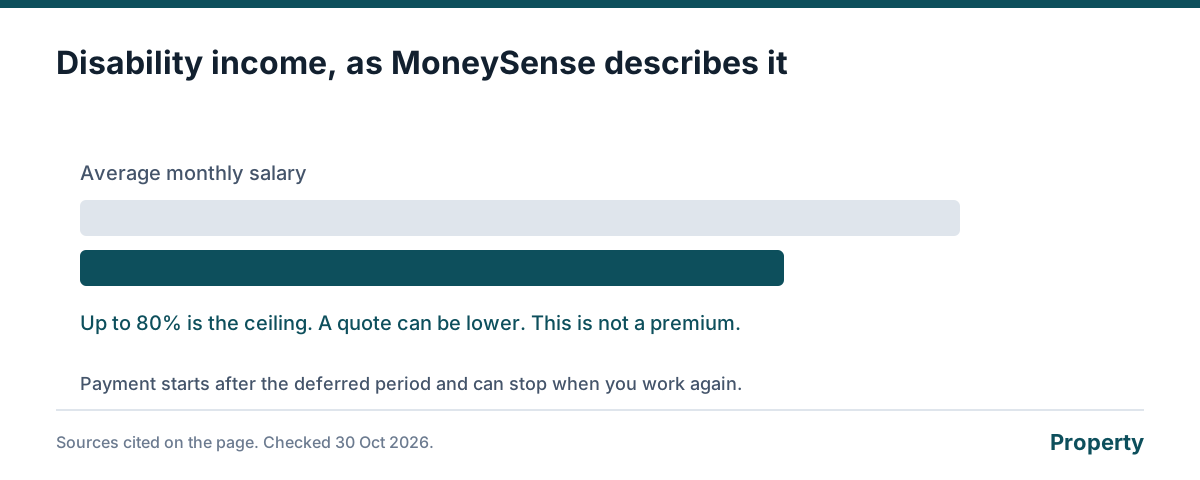
- Disability income is monthly, up to 80% of average salary.
- You can fail a TPD test and still be unable to do your job.
- The monthly benefit stops or shrinks when you recover. The lump sum does not come back.
The numbers
- TPD
- Lump sum, life policy definition
- Disability income
- Monthly, up to 80% of salary
- Wait
- Deferred period on the income policy
- Recovery
- Income benefit can stop. TPD was already paid
- MAS lump-sum guide
- 9 times income for death and TPD
The short answer
TPD versus disability income is the difference between a cheque and a wage. Total and permanent disability on a life policy pays a lump sum if you meet that policy’s definition, which is often severe: you cannot do any job, or you cannot perform several activities of daily living, or you have a listed impairment. Disability income pays a fraction of your salary, up to 80% in MoneySense’s description, after a deferred period, for a limited time, and it stops when you can work again.
You can be unable to do your job for a year and never trigger TPD. You can meet TPD and still want a monthly benefit if the lump sum has a job of its own, such as a mortgage.
Definitions you must not merge
MoneySense tells you to clarify the disability definition because it varies and the premium depends on it. We will not announce that “own occupation” is the Singapore standard. We will say: if the income policy says own occupation and the life policy says any occupation, they are two tests. Passing the easier one does not pass the harder one.
| TPD on a life policy | Disability income | |
|---|---|---|
| Shape | Lump sum | Monthly |
| Size guide | 9 times income is the MAS death and TPD guide | Up to 80% of average monthly salary |
| Wait | The definition itself is the hurdle | A deferred period of unpaid months |
| Recovery | You have the money. The cover for that benefit is spent | Payments stop or reduce |
| Illness and injury | As the life policy defines TPD | Both, if they stop you working under that definition |
How a household can hold both without double-thinking
Use the lump sum for debts and for a period of reset. Use the monthly benefit for the living costs that continue. Do not subtract the TPD sum from the income need as if they were the same unit. The term calculator sizes the lump sum. The income page sizes the 80%. The unpaid months are the deferred period. The hub is the cluster. We are not an adviser.
Send me quotes for these figures
What you need before a quote
- Flat type, or condo and floor area
- What the contents would cost to replace
- What the renovation cost
- Age of the building, if you care about seepage tracing
- Whether you live there or rent it out
Other ways to compare in Singapore
- compareFIRST, the life-insurance shelf MoneySense points to. Direct Purchase plans there are commission-free up to the published cap.
- The insurer's own site, if you already know the product and want its illustration.
- A licensed insurance broker you choose. We do not name one and we do not publish a phone number for one.
- A bank that distributes the policy, if that is where you bank. Ask them what they are paid. We do not list a rate.
- The calculators on this site, which show a result before you send a form.
Questions on this topic
If I cannot do my own job, is that TPD?
Not necessarily. Many TPD definitions require that you cannot do any occupation, or that you cannot perform a set of daily activities. Own-occupation income cover is a different sentence. Ask which one is in each contract.
Should the TPD lump sum be spent as a salary?
It can be, and then it is gone. Disability income is the contract designed to be the salary. Using the lump sum for the loan and the income policy for the groceries is a coherent split.
Does CareShield count as either?
No. CareShield pays for severe disability measured by activities of daily living. It is long-term care, not TPD and not a salary.
Can I claim both?
If you meet both definitions, yes, they are separate contracts. One claim does not prove the other.
Is it free?
Yes. The calculators and guides are free. A result appears in your browser before anyone asks for a phone number. Sending the form, if you want quotes for those figures, does not add a fee on this website.
Will you call me?
Not because you opened a page. We contact you only if you send the form or message us. You can read every result with the form left blank.
How does this site work?
The page does the arithmetic in your browser from the rules and the numbers you type. If you ask for quotes, we use your name, number and those figures only to reply about that enquiry. We do not sell the list. Personal data is handled under Singapore's Personal Data Protection Act. We are not an insurer and this is not financial advice.
Get a personalised breakdown
The calculator above runs in the browser with no phone number. Leave your details only if you want quotes or an audit for the same figures.
Sources
Facts on this page were checked against these sources on 30 October 2026.
- MoneySense: Understanding disability income insurance, updated 28 September 2026 moneysense.gov.sg, checked 30 October 2026
- MoneySense: Assessing your insurance needs moneysense.gov.sg, checked 30 October 2026
- MAS: Basic Financial Planning Guide mas.gov.sg, checked 30 October 2026
- MoneySense: Understanding health insurance moneysense.gov.sg, checked 30 October 2026
Fact-checked against HDB, IRAS, CPF, MAS.
