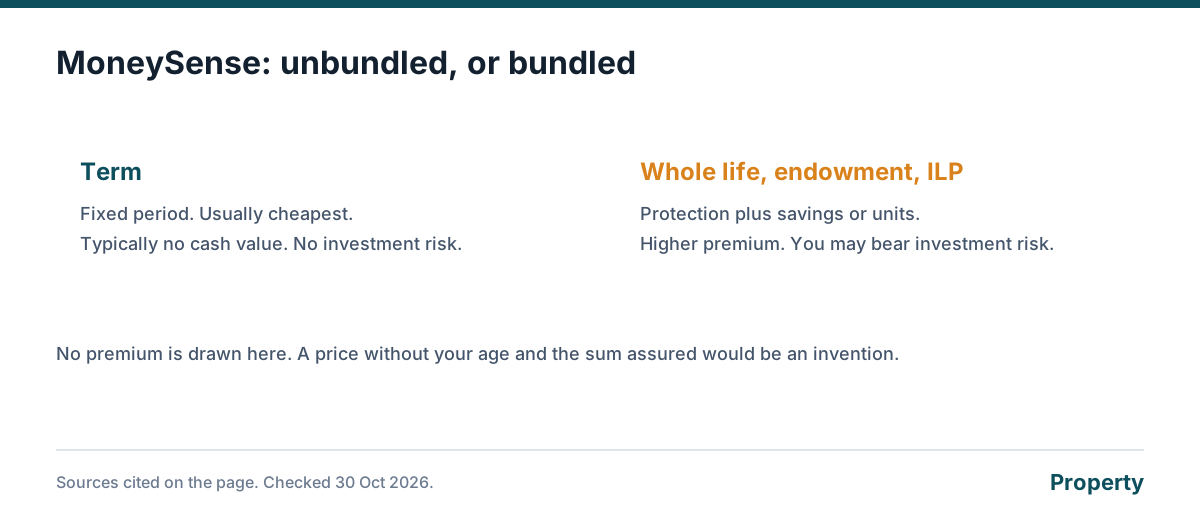
MoneySense: term cover is for a fixed period and usually costs less; whole life, endowment and ILP bundle protection with savings or investment, cost more, and the non-guaranteed part is investment risk you bear. This calculator compounds the premium gap once a year at the end of the year. It ignores taxes, fund fees beyond the premium you typed, and the chance you stop paying. A higher assumed return makes the invested pot larger. It does not make that return likely.
How we calculate
The gap is the bundled premium minus the term premium. It is saved at the end of each year. At 0% the pot is the gap times the years. Above 0% it is the ordinary future value of that annuity. The last tile subtracts a surrender value only if you typed one.
Inputs
- Annual term premium
- Annual bundled premium
- Years
- A return you choose
- Optional surrender value from an illustration
Assumptions
- 0% is the default and is not a forecast
- The return is yours, not an illustrated bonus
- Tax, lapses and charges outside the premium are ignored
Constants and where they come from
| Constant | Value used | Source |
|---|---|---|
| Why term is usually cheaper | MoneySense: term is unbundled and typically has no cash value | moneysense.gov.sg |
On this page
Key takeaways
- Gap per year equals bundled premium minus term premium.
- We compound it once a year, at the end of the year.
- 0% is allowed, and it is the honest default.
- An illustrated cash value is typed, never generated here.
The numbers
- Formula
- End-of-year contributions at the rate you type
- At 0%
- The gap times the number of years
- If term costs more
- There is nothing to invest
- Surrender value
- Only from your illustration
- What it ignores
- Fees beyond the premium, tax, and you stopping early
The short answer
Buy term and invest the difference is a subtraction. Take the annual premium of the whole life, endowment or ILP. Subtract the annual premium of a term plan with a sum assured you actually want. What is left is the difference. Save that amount at the end of each year for the number of years you are comparing, at a yearly rate you are willing to type.
At 0% the future value is the difference times the years. There is no growth to argue about. At a rate above zero the calculator uses the ordinary compound-sum formula for a payment at the end of each year. It says so on the page. It is not an insurer’s illustrated bonus.
What you must type, and what you must not expect
You need two real premiums. A remembered “whole life is about three times term” is not a calculation. If the term premium is higher, the gap is zero and the slogan does not apply to that pair. Look at the sums assured before you treat a cheap bundle as a win.
The surrender or cash value box is optional. Copy it from the benefit illustration at the same year. The last tile is your invested pot minus that illustration. Positive means the pot is larger at the rate you assumed. It does not mean you will earn the rate. It ignores tax, the chance you stop the term plan, and charges that were not already inside the premium you typed.
| Input | Source |
|---|---|
| Term premium | A quote for the sum and the term you need |
| Bundled premium | The illustration, same currency, per year |
| Years | The term you will actually keep |
| Return | Your assumption. Use 0% to see premiums only |
| Cash value | The illustration’s surrender column, or leave blank |
A worked shape, not a worked premium
Suppose the bundle is S$1,920 a year more than the term, for 20 years, and you type 0%. The pot is S$38,400. That sentence uses your inputs the way the calculator does. It is not a market premium, and it is not on this page as a default you should treat as typical. The behaviour page is whether you will do it. The cash value page is what the illustration’s number means. The hub is the cluster. The 9 times income test sits on the term calculator. We are not an adviser.
What you need before a quote
- Annual income and take-home pay
- Cover you already hold, including DPS if you are in it
- The two annual premiums, if you are comparing term with a bundle
- A surrender value copied from an illustration, if you have one
Other ways to compare in Singapore
- compareFIRST, the life-insurance shelf MoneySense points to. Direct Purchase plans there are commission-free up to the published cap.
- The insurer's own site, if you already know the product and want its illustration.
- A licensed insurance broker you choose. We do not name one and we do not publish a phone number for one.
- A bank that distributes the policy, if that is where you bank. Ask them what they are paid. We do not list a rate.
- The calculators on this site, which show a result before you send a form.
Questions on this topic
Why end of year?
So the sum is simple and stated. Monthly investing would land a bit higher at the same rate. We do not pretend to model a broker's cash sweep.
Should I use the illustrated 4.25% or whatever is on the brochure?
Not in the return box. That illustrated rate is the insurer's scenario. Put the surrender value they printed into the surrender box, and keep the return as your own assumption.
What if the whole life quote is cheaper?
Then this pair of quotes does not produce a gap. Check the sums assured. A cheaper bundle with a much smaller payout is not a bargain.
Does this include critical illness?
Only if the premiums you typed are for policies that include it. The calculator does not add CI on its own. The 4 times income guide is a separate sum.
Is it free?
Yes. The calculators and guides are free. A result appears in your browser before anyone asks for a phone number. Sending the form, if you want quotes for those figures, does not add a fee on this website.
Will you call me?
Not because you opened a page. We contact you only if you send the form or message us. You can read every result with the form left blank.
How does this site work?
The page does the arithmetic in your browser from the rules and the numbers you type. If you ask for quotes, we use your name, number and those figures only to reply about that enquiry. We do not sell the list. Personal data is handled under Singapore's Personal Data Protection Act. We are not an insurer and this is not financial advice.
Get a personalised breakdown
The calculator above runs in the browser with no phone number. Leave your details only if you want quotes or an audit for the same figures.
Sources
Facts on this page were checked against these sources on 30 October 2026.
- MoneySense: Comparing term and bundled life insurance moneysense.gov.sg, checked 30 October 2026
- MAS: Basic Financial Planning Guide mas.gov.sg, checked 30 October 2026
Fact-checked against HDB, IRAS, CPF, MAS.
