On this page
Key takeaways
- Your bill is share value times the rate the MCST set, usually billed quarterly.
- Share value is on the strata title. A larger unit usually has more shares, not always in proportion to floor area.
- The fee covers common property. It does not cover your air-conditioner or your inside repairs.
- A special levy is extra, voted when the sinking fund cannot pay a large repair.
The numbers
- Who sets it
- The management corporation, at a general meeting
- Your multiplier
- The unit's share value
- Two pots
- Management fund and sinking fund
- Not included
- In-unit repairs, your own utilities, property tax
- HDB comparison
- Service and conservancy charges, a different regime
The bill is a rate times your shares
Every strata unit has a share value. The management corporation, the MCST, sets how much to collect per share for the management fund and for the sinking fund. Your quarterly bill is that rate multiplied by your shares, plus any extra the by-laws allow, such as late interest you have already incurred. A three-bedroom with 8 shares in a project charging S$80 a share a month pays S$640 a month, S$1,920 a quarter. A two-bedroom with 6 shares in the same project pays S$480 a month. The S$80 is an example of the arithmetic, not a Singapore average. Replace it with the rate on the bill the seller shows you.
That is the whole comparison method. Ask two sellers for share value and the current contribution per share. Multiply. A project that looks expensive per share can be cheap for a small unit, and the reverse. Floor area is a rough guide to share value and not a substitute. The schedule of strata units is the document.
What the fee is for
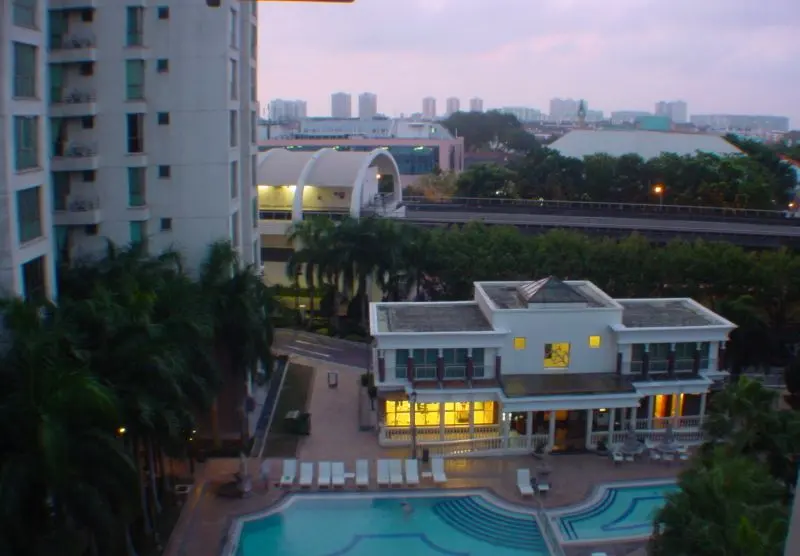
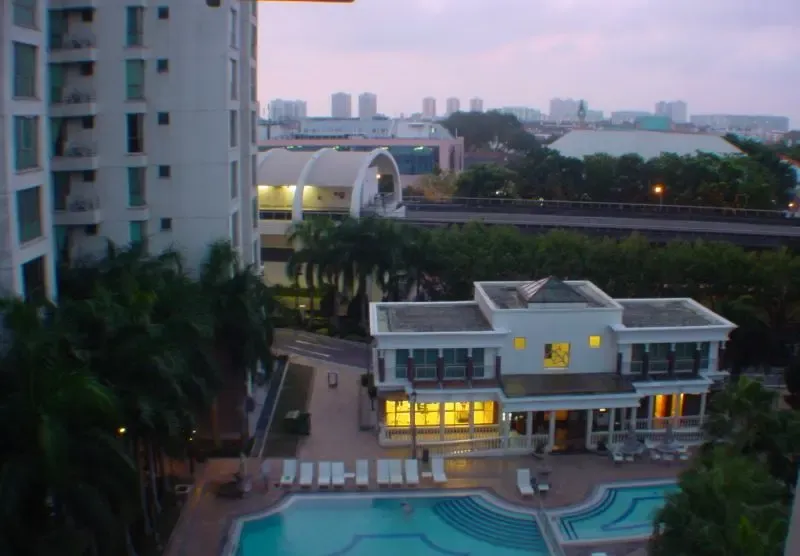
Common property: lifts, the pool, gardens, security, cleaning of common areas, the managing agent’s contract, insurance of the building as a whole. The sinking fund is the capital pot for repainting, lift replacement and other work that does not belong in a single year’s cleaning budget. A low quarterly fee with an empty sinking fund is a future special levy. Minutes of the annual general meeting show whether owners have been voting contributions that match the engineer’s reports.
What it does not cover: your air-conditioning, your washing machine, painting inside your unit, your electricity, and your property tax. Owners who add “maintenance” as a single number in a yield spreadsheet should split MCST, tax and repairs. The yield calculator has separate fields so a low fee is not hiding a high tax bill. A fully rented condo pays non-owner-occupier property tax. That tax is often larger than the MCST fee and is not reduced by living on a low floor.
A worked quarter
Unit share value 7. Management fund S$55 per share per month. Sinking fund S$25 per share per month. Both figures are the ones you would read off a bill, and here they are only a template.
| Line | Amount a month | A quarter |
|---|---|---|
| Management, 7 times S$55 | S$385 | S$1,155 |
| Sinking fund, 7 times S$25 | S$175 | S$525 |
| Total contribution | S$560 | S$1,680 |
If the AGM has voted a special levy of S$2,000 per share, spread over a year, that is 7 times S$2,000, which is S$14,000 in that year, about S$1,167 a month on top. Special levies are how facades and spalling concrete get paid when the sinking fund was kept artificially low to win buyers. Read five years of minutes, not the latest glossy budget.
On a S$1,400 monthly rent, S$560 of MCST is 40% of one month, or about 4.8% of the annual rent before tax and vacancy. Yield rankings that ignore it are gross yields. The highest yield leaderboard says so in its method. Use gross yield to screen. Use the bill to decide.
New launch versus a 20-year-old estate
A launch has no arrears and no voted levy. It also has no evidence. The developer’s maintenance estimate in the brochure is a projection. Owners can raise it at the first AGM after the management corporation is theirs. A 20-year-old estate has a record. High fees there can mean a pool and concierge, or they can mean a building that is catching up on repairs. The new launch versus resale page treats this as one of the reasons to read minutes before you exercise an option.
HDB service and conservancy charges are a different system, set with the town council, and they are much smaller than a full-facility condo. People moving from a flat to a condo feel the jump. Put the condo quarterly bill next to the flat’s S&CC before you decide the condo’s price per square foot was the only cost that mattered. The condo versus landed guide makes the same point in the other direction: a landed house has no MCST, and it has a roof that is entirely yours.
At purchase and at sale
Ask the seller for the latest bill and a statement of arrears. Your lawyer should confirm on completion that contributions are paid up to the apportionment date. You pay from completion onward, and the days are split. A seller who is three quarters behind will be made to clear it in the completion account, or you will inherit a problem. The selling guide tells sellers to have those bills ready for the same reason.
Non-payment by other owners is the estate’s problem and, if it is widespread, your problem. A building with heavy arrears struggles to fix the lifts. The audit notes in the AGM pack mention arrears. If they are large relative to the annual budget, treat the low headline fee as unreliable.
There is no table in this guide of “typical fees by district” because that table would be invented. The method is the rate, the shares and the minutes. Bring those three to the viewing. The price negotiation can include a special levy that has already been voted. It cannot include a fee you have not seen.
Putting the fee next to the loan
A buyer stretching to a S$1,800,000 condo looks at the instalment and forgets S$600 a month of MCST. Over a year that is S$7,200, which is real cash after the mortgage. On a gross yield it is one of the subtractions. On a monthly budget it is the bill that arrives even in a month when the air-conditioner breaks, because the air-conditioner is not the MCST’s. Keep a separate repair float. A common rule of thumb among owners is a few thousand dollars a year for in-unit kit. That rule of thumb is not a statistic from URA. It is a reason to ask the seller which appliances stay and how old they are, during the 14-day option, while you can still walk away for the price of the 1%.
If you are a landlord, the MCST fee is an expense against rental income if you claim actual expenses, and it is not added on top of the 15% deemed-expense shortcut. You do not claim both the 15% and the full MCST. The rental income tax guide will set that out. The fee is still payable whether you claim it or not.
What to request from the agent
The current tax invoice, the share value, the financial year of the MCST, and the last AGM minutes including any levy resolution. If the agent says the fee is “around S$400” without shares and a rate, you do not have a number. “Around” is how a S$700 bill becomes a surprise. Write the quarterly figure into the total cost calculator only as a note beside renovation. The calculator’s renovation line is not the MCST. They are different decades: renovation once, MCST every quarter until you sell.
A landed house avoids this bill and concentrates the risk in the roof, the air-conditioning and the driveway, all of which are yours alone. That is a fair trade only if you have priced those repairs. The landed guide is where that budget starts. Condo fees are the price of sharing the pool. They are worth paying when the minutes show the pool is actually maintained.
Questions on this topic
How much is condo maintenance in Singapore?
It is the rate your management corporation charges per share value. Two projects can differ by a wide margin because of pools, lifts, security and how well the sinking fund was built. Get the current quarterly figure for the unit, not a citywide average.
What is share value?
The number of shares the unit holds in the strata title. It drives both the bill and the voting weight. It is fixed in the schedule, not chosen by the owner each year.
Does the fee include property tax?
No. Property tax is charged by IRAS on the annual value and billed to the owner. The MCST fee is the estate's own charge.
What if I do not pay?
The management corporation can pursue the arrears, and a buyer will see them at completion. Unpaid contributions can hold up a sale. Pay them, or the completion account will.
Are new launches cheaper to maintain?
Not by rule. A new estate has warranties at the start and a thin financial history. The first budgets are the developer's. The owners vote the real rate after they take over.
Get a personalised Singapore shortlist and financing check
Share your budget and what you're comparing. We'll reply on WhatsApp with matching units, recent caveats and your exact cash/CPF breakdown.
Sources
Facts on this page were checked against these sources on 30 October 2026.
- BMSMA: Building Maintenance and Strata Management Act sso.agc.gov.sg, checked 30 October 2026
- IRAS: residential property tax, separate from MCST fees iras.gov.sg, checked 30 October 2026
Fact-checked against HDB, IRAS, CPF, MAS.